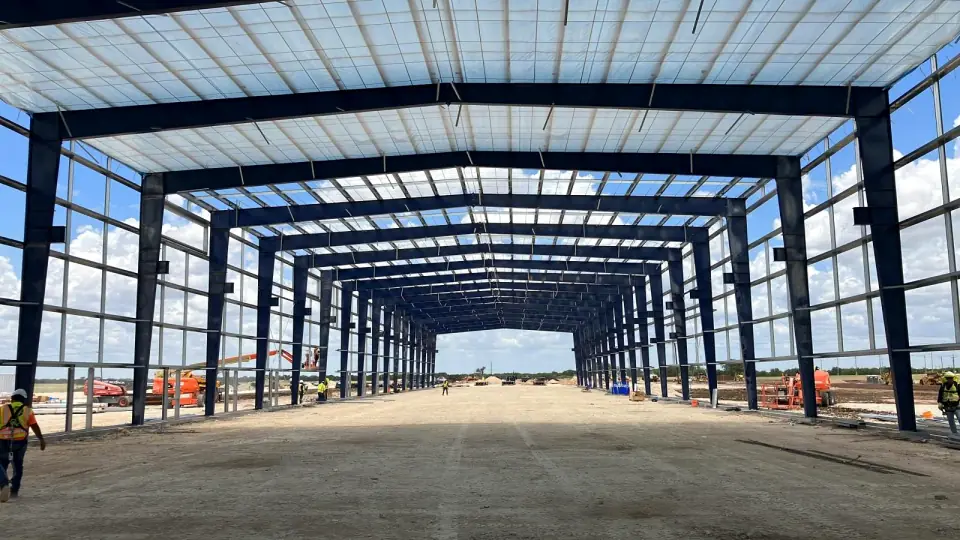
Steel structures for buildings, premises and businesses
We design and install steel structures for buildings, retail premises, restaurants, offices and all kinds of businesses. We solve structural refurbishments, extensions, change of use, reinforcements and new builds, with exposed or clad finish per project. We work compatibly with the premises' activity whenever possible.
Steel structures for buildings
Steel structures for buildings cover both new builds (composite floor decks, HEB columns) and refurbishment (reinforcements, replacement of deteriorated elements, adding storeys). In new builds, the combination of steel columns with composite steel-deck and concrete floors is very common in public buildings, offices and car parks. It allows short timelines, immediate use of the floor as a working platform and excellent integration with the other trades.
In refurbishment, the steel structure stands out for its ability to adapt to existing geometries without the need for demolition. Replacing a deteriorated timber beam with an HEB section, reinforcing a joisted floor with connectors welded to a new composite deck, or adding a new storey on top of an existing structure are routine interventions in older buildings in the city centre.
- Composite floors with profiled steel sheet and concrete
- HEB columns and IPE/HEA beams in new builds
- Reinforcement of existing floors with welded connectors
- Replacement of deteriorated joists
- Vertical extensions on top of an existing structure
- Opening of perimeter openings with reinforcement
Structures for commercial premises and restaurants
Commercial premises and restaurants are one of the niches where the most steel structure is built. Replacing inconvenient load-bearing walls with beams, opening large openings to the outside, creating lofts for storage or offices, extending a premises by adding a second bay: all are interventions resolved with steel beams, columns and mezzanines designed for the specific case.
A particular feature of these projects is that closure of the premises almost always has to be minimised. We work in phases, in evening and night-time hours when the premises is closed, and we fabricate most of the work in the workshop to limit noise and dirt on site. It is common to deliver the finished structure over a long weekend if the project allows.
Upload drawings or describe your idea. We reply with a realistic quote in 48h.
Reinforcements and extensions of existing structures
An important part of the work is upgrading existing structures for new uses: converting a storage premises into a gym (different loads), turning a flat into an office with filing racks, installing heavy machinery in a warehouse that was not designed for it, or increasing roof loads for a large solar installation. Each case requires a prior inspection, a review calculation and, where appropriate, localised reinforcements with welded plates, column jacketing or additional beams.
Exposed structure vs clad structure
More and more retail and hospitality projects look for exposed structure as a decorative element: columns and beams painted in an industrial colour, careful welding, clean lines. Exposed structure demands special attention to the shop finish (corners, surfaces, welding) and, usually, fire protection with intumescent paint so as not to lose the metallic look. The alternative, structure clad with a suspended ceiling or dry lining, is common in offices and housing.
- Exposed structure, painted or galvanised, with a decorative finish
- Intumescent paint when R30/R60 is required while keeping the metallic look
- Clad structure with a suspended ceiling or fire-rated board dry lining
- Special finishes in hospitality: controlled rust, RAL lacquering, polished
Compliance with fire safety regulations
Steel structures in buildings must comply with the CTE DB-SI for fire resistance, which varies according to the use, the height and the fire compartmentation of the building. In offices and premises up to 28 m in height, R30 to R90 is required depending on the storey. Protection is resolved with intumescent paint (more aesthetic and compatible with exposed structure) or with board dry lining or sprayed mortar (more economical when the structure is not left exposed).
Related services
These services are typically combined with buildings & premises within the same project:
- Steel structures for industrial warehouses: We build industrial warehouses with steel structure: engineering, fabrication and turnkey installation for warehouses, workshops and logistics hubs.
- Steel fabrication and installation: Full-service shop fabrication and on-site installation of steel structures. In-house crews, EN 1090 certified welding and on-time delivery.
- Steel structure company: Specialist steel structure company for industry, construction and bespoke projects. In-house engineering, workshop and installation crews on staff.
- Steel structure pricing: How much does a steel structure cost: factors that drive price (m², kg, installation). Receive a realistic quote in 48h.
- Metal roofing: Design and installation of metal roofing for warehouses and buildings: sandwich panel, corrugated steel sheet, deck and replacement of old roofs.
Areas where we deliver buildings & premises
We work all over Spain. If your project is in one of these cities, browse the local page for typical project types and area-specific notes: