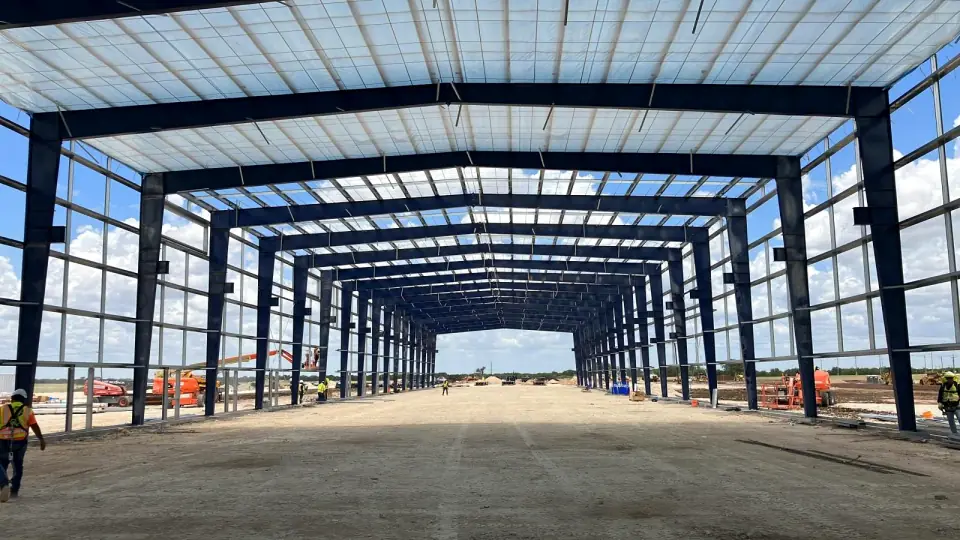
Steel trusses
Steel trusses solve roofing of large spans without intermediate columns. We design and fabricate trusses to spec for industrial warehouses, sports halls, logistics buildings, workshops and refurbishments seeking column-free space. Each truss is calculated based on span, loads and available geometry, optimising steel weight and fabrication cost.
What a steel truss is and when it pays off
A steel truss is a triangulated structure made up of members (chords, verticals and diagonals) that work in tension and compression. This triangulated geometry allows it to span much greater openings than a solid-web beam with less steel weight. From 12 to 15 metres of span the truss starts to be more efficient than a beam, and beyond 20 metres it becomes the standard solution.
Trusses are typically used in industrial warehouses without intermediate columns, sports halls, workshops with overhead cranes, warehouses with high-bay racking and refurbishments where the aim is to free up interior space. They are also common in distinctive roofs of public buildings and in decorative exposed structures.
Truss types: Pratt, Howe, Warren, Belgian and English
There are several truss types depending on the arrangement of verticals and diagonals. The choice of one type or another responds to span, anticipated loads and, to a lesser extent, aesthetic preference when the truss is exposed:
- Pratt: diagonals in a V towards the centre, efficient under vertical loads (industrial roofing)
- Howe: diagonals in a V towards the ends, optimal when there are high loads at the centre
- Warren: zigzag diagonals, visual lightness, common in footbridges
- Belgian (or king-post): classic triangulation for small and medium gable roofs
- English: a variant with many verticals, robust, for large spans
- Tubular trusses with welded rectangular profiles, a clean finish for exposed structures
Upload drawings or describe your idea. We reply with a realistic quote in 48h.
Design and calculation based on span and loads
The design of a truss begins by defining span (distance between supports), spacing between trusses (modulation), pitch and loads. From there we choose the truss type and size each member: top and bottom chords with rolled or tubular profiles, verticals and diagonals with angles, rounds or tubes depending on the design. Connections are calculated as shop-welded joints and, in some designs, bolted on site to ease installation.
For spans from 25 to 30 metres, we optimise the truss depth (span-to-depth ratio between 8 and 12 depending on the type) to reduce kg without losing stiffness. On roofs with significant snow load, the truss is oversized in its central section. In seismic environments (parts of the southern peninsula and Murcia), the calculation incorporates additional coefficients in accordance with NCSE-02.
Fabrication, transport and installation
Trusses are fabricated entirely in the workshop when transport allows. For spans up to 18 to 20 metres, a standard lorry takes the complete truss; beyond that, it is delivered in two or three sections that are bolted or welded on site. When there are clearance restrictions (narrow roundabouts, difficult site access), we assess special transport and permits.
Installation is carried out with a self-propelled crane sized for the weight and the lifting height. The truss is raised into position, anchored to the supporting columns or walls, and the longitudinal bracing that stabilises the assembly is tied in. In sports halls and large warehouses, installation is planned in phases to avoid temporary instabilities.
- Full workshop fabrication with dimensional control
- Single-piece transport up to 18 to 20 m span
- Bolted or site-welded sections for larger spans
- Installation with a self-propelled crane sized to the weight
- Longitudinal bracing for stability
- Visual inspection and geometric verification on site
Most common applications
Trusses take centre stage in projects where open, column-free space is key:
- Industrial and logistics warehouses with spans of 20 to 40 m without columns
- Workshops with an overhead crane hung from the truss itself
- Covered sports halls and sports pavilions
- Warehouses with high-bay racking systems
- Refurbishment of old warehouses with replacement of interior columns
- Distinctive roofs of public and community buildings
- Decorative exposed structures in hospitality and retail
Related services
These services are typically combined with steel trusses within the same project:
- Steel structures for industrial warehouses: We build industrial warehouses with steel structure: engineering, fabrication and turnkey installation for warehouses, workshops and logistics hubs.
- Steel fabrication and installation: Full-service shop fabrication and on-site installation of steel structures. In-house crews, EN 1090 certified welding and on-time delivery.
- Steel structure company: Specialist steel structure company for industry, construction and bespoke projects. In-house engineering, workshop and installation crews on staff.
- Steel structure pricing: How much does a steel structure cost: factors that drive price (m², kg, installation). Receive a realistic quote in 48h.
- Metal roofing: Design and installation of metal roofing for warehouses and buildings: sandwich panel, corrugated steel sheet, deck and replacement of old roofs.
Areas where we deliver steel trusses
We work all over Spain. If your project is in one of these cities, browse the local page for typical project types and area-specific notes: